At ESnet, Innovation and Collaboration Build Solutions for Today and Tomorrow

Inder Monga reflects on 2022’s highlights and looks ahead to the future.

ESnet Executive Director Inder Monga at the launch event celebrating the unveiling of ESnet6, the sixth generation of the Department of Energy’s (DOE’s) dedicated high-speed scientific network.

Dear Friends, Well-wishers, Colleagues, and all of ESnet,

It’s been less than a year since ESnet formally introduced ESnet6, the latest iteration of the U.S. Department of Energy’s Energy Sciences Network. And we’ve already made much progress in enhancing research capabilities and data sharing across a broad spectrum of scientific applications.

For more than 35 years, ESnet – headquartered at Lawrence Berkeley National Laboratory – has served as the data circulatory system for the DOE, connecting all of its national laboratories, tens of thousands of DOE-funded researchers, and DOE’s premier scientific instruments and supercomputing centers. This interconnected system enables data to move quickly between sites and collaborators, accelerating time-to-discovery.

ESnet6, unveiled in October 2022 in conjunction with Confab, our first user meeting, takes the network’s capabilities to the next level. ESnet6 represents a transformational change in the way networks are built for research, with improved capacity, resiliency, and flexibility. With more than 46 Terabits per second of aggregate bandwidth deployed, it features a significant increase over prior generations of the network. This boost in capacity enables scientists to more quickly process, analyze, visualize, share, and store the mountains of research data produced by experiments, modeling, and simulations.

But the new network – which was completed under budget and ahead of schedule – does more than just increase capacity. With ESnet6, our engineers have developed smart, programmable, and automated services uniquely built to support the multi-petabyte dataflows typical of science research today. In addition, they are future-proofed to manage the emerging exabyte data era, streaming data from instruments and high-impact digital twins that require predictability and low latency. 

For example, ESnet is a critical component of Berkeley Lab’s Superfacility Project, which offers researchers seamless analysis of their experimental data in real time and regardless of their location. Additionally, with the recent ‘Superlab’ demonstration of the ARIES project by the National Renewable Energy Laboratory (NREL), we demonstrated how these new capabilities can be used to “address large-scale emergent challenges to meet the nation’s clean energy goals and to reinforce the energy security needs of every community,” as Rob Hovsapian, ARIES research lead in hybrid energy systems at NREL, noted in a collaborative news release announcing this project. With this in mind, we’re already looking to what users and stakeholders would like to see next.

Four strategic thrusts will define our efforts: 

  1. Transform Operations: While priority one is to operate a highly performant and robust network, we are also exploring new architectures, infrastructure enhancements, improvements to business processes, additional orchestration and automation capabilities, and ways to integrate new technologies like AI/ML – all to improve the resiliency, efficiency, and effectiveness of the user facility.
  2. Expand Services Portfolio: Our current services are foundational to the national labs and science communities. As we enter into an exascale era, with data-intensive instruments and widely distributed experiments, the network will play a key role in providing critical data services and supporting distributed data workflows, both for our scientists and the sites. The staff continue to innovate, experiment, prototype, and transition to production new data and network services. In addition, we actively look to expand the modalities through which scientists acquire data, from private 5G to low-Earth-orbiting satellites in remote locations, and potentially through quantum networks.
  3. Increase Stakeholder Value: As high-speed and big-data networking experts, we can co-design solutions based on upcoming requirements with our scientific and site user community to ensure that ESnet provides the most value to all of DOE as well as the worldwide research and education community stakeholders.
  4. Build Accountability and Transparency: We will foster the culture of accountability and transparency that provides the right environment for our users and our employees to perform at their personal best. 

ESnet exemplifies the team science value of Berkeley Lab. Our partnerships with all of the DOE national labs, vendors, global research and education networks, and academia have been essential to the design and build of ESnet6 and our future endeavors. Our integration of experimental, networking, and computational facilities gives scientists the ability to take a giant leap forward in gaining insight from massive datasets produced by experiments that use large-scale instruments such as genome sequencers, telescope observatories, X-ray light sources, and particle accelerators, among many others. We know we cannot do this alone. Participating in community-based collaborative initiatives better positions us to address future needs for all users and stakeholders. Some examples include:

  1. Co-design with science collaborations: SENSE/Rucio integration (collaboration with U.S. CMS [Compact Muon Solenoid experiment]) and GRETA networking (collaboration with Nuclear Physics) in co-designing data/science workflows with scientists.
  2. Open source contributions: Collaborating with and contributing to the SURFnet Workflow Orchestrator for network automation. (Please see the “From Zero to Orchestrated—A Workflow Orchestrator Beginners’ Workshop” at TNC, June 2023, co-organized with SURFNet.) Contributions to perfSONAR, iperf3, Grafana, and many others are part of ESnet’s work with the larger networking community.
  3. Strategic collaborations with worldwide R&E partners: Transatlantic MOU with ANA (Advanced North Atlantic) collaboration partners to make “gap on oceans” irrelevant when it comes to scientists.
  4. Enabling impactful networking research through multi-organization collaboration: Research collaborations on the FABRIC Testbed to supercharge network and distributed systems research within the U.S. and internationally. The Berkeley Lab–led Quantum Testbed (QUANT-NET) will accomplish the same for quantum communications and computing.

We are applying the same thoughtfulness to our staffing efforts. People want to work in organizations that have meaningful impact and contribute to humanity, and we are building the foundation to support this. Between 2018 and 2022, ESnet grew by 200%, hiring and adding a diverse array of skillsets to realize a dedicated staff of more than 100. As we look to the future, we strive to build a balanced workplace that represents a diversity of backgrounds, skillsets, regions, and states. 

Ultimately, ESnet’s success depends on the sum of its people – those who work in or with our organization have ample opportunity to have a meaningful impact on humanity and science.

Ultimately, ESnet’s success depends on the sum of its people – those who work in or with our organization have ample opportunity to have a meaningful impact on humanity and science. In addition to our commitment to next-generation enabling technologies, this is a key focus for ESnet over the next 10 years and beyond. ESnet6 is designed to support the DOE’s multi-billion dollars of investments in scientific research that touches our everyday lives, and we will continue to invest in these and related technologies, services, and people to support the needs of the DOE, HPC, and global science communities. 

The ESnet Portal: Visualizing the Network

As a facility that provides reliable, high bandwidth interconnectivity to scientists at national laboratories, universities, and research institutions, it is important for ESnet to share timely and accessible information about the network and its current status. The my.es.net portal has been an innovative place for sharing this information since its inception. 

Following a six-month upgrade project, ESnet’s public-facing portal now provides improved visualization capabilities. It allows users to easily view the core network and its connections to national lab sites. With this updated version, users can now see the network in a more detailed view that also provides the ability to zoom in and pan. By utilizing an in-house developed network visualization library, this enhanced version synthesizes a longer time range of data to provide faster, more accurate, and more detailed network topology updates.

You can experience the new version and look at all its new capabilities at https://my.es.net

Building on a Treasure Trove of Measurement Data

In 2021, ESnet rolled out its Stardust system, which collects precise network measurement data and allows users to retrieve information about specific equipment over a given time range. This updated release builds on Stardust’s capabilities, giving users a window into measurement data over the entire network topology.

A New View of the Network

Historically, ESnet’s portal has only offered a logical view of the network, visualizing the connections between sites but only approximating the network footprint. The updated version offers two visualization options: an updated and expanded logical “subway-style” view and a geographically referenced view. While building both views of the network, care was taken to strike a balance between providing a visualization that is as rich and accurate as possible while minimizing visual clutter. The approach uses interactive layers to help target the most important network information.

ESnet pictured in “logical” view

ESnet pictured in “geographic” view

Understanding Network Utilization

One of the most important things to understand when building and maintaining a network is measurements of bandwidth utilization, particularly at peak and near-peak conditions. To give users a clearer understanding of these key peak bandwidth utilization measurements, the map sends Stardust queries for traffic aggregations that display the “95th percentile,” or near-peak traffic, and a “maximum,” or peak measurement for a given period of time. These measurements give a sense of the “high water marks” for the network, letting ESnet know when a “flood” might occur and helping visualize the available headroom and plan for times of highest utilization.

Map (with options) picturing the “high water marks” for the last week

Tools for the Future

In conjunction with ESnet’s Stardust system, this update to the portal allows for much more responsiveness to changes in the network topology in the future. When a new router or site is added, ESnet can bring a visualization of it online in minutes rather than days. 

With this added capability and flexibility, ESnet may enhance site-centric capabilities, providing tailored views or new network layers (e.g., layers of university sites or peering points with commercial and R&E networks) to better inform users.
The portal’s new visualization of ESnet is a significant upgrade that provides researchers, network engineers, and other stakeholders with a more comprehensive, detailed, and accurate view of our network. With new statistical methods, more extensive time-based analysis, and a greater range of visualization capabilities, our portal update provides valuable insights into network behavior and performance. If you’re an ESnet user, check out the new tool and see how it can help you understand the network in greater detail.

Simplification and Advancement in Segment Routing with Nicholas Buraglio

Segment Routing is a way to increase network efficiency by prepending a set of route instructions to a packet, allowing it to traverse directly to a specific destination. Much has been said about advantages and disadvantages of segment routing in the networking industry. There are the more obvious advantages like the ability to simplify the network and reduce resource utilization and reducing the number of nodes that need to be touched for path provisioning and changes but there are also many limitations. 

In this blog piece, Nicholas Buraglio, computer systems engineer on the Planning and Architecture team, discusses segment routing in scientific networks and how it can be highly beneficial. 

Segment Routing: Simplification and Advancement for Science Networks

Over the last few years, much of the networking industry has been abuzz about segment routing (SR) – a technology that seemingly straddles the line between the promised benefits of software defined networking (SDN) and the operational needs of large, complex, geographically diverse networks. Meeting that confluence of “granular control” and extreme scalability is no easy task. Add to that the prospect of simplification of a well known complex and uncommon set of controls and protocol stacks, and one starts to understand why SR is so highly desirable. 

So what is SR and what does this solution bring that makes it so desirable? In a nutshell, SR is a networking technology that combines the features of Multi Protocol Label Switching (MPLS), with the flexibility of SDN. It allows for controller augmented and source-based routing without the need for maintaining state across a network core and for seamless fallback to traditional network protocols in the case of failures. Alone, each of these attributes are very compelling, but together they make for an extremely robust solution. SR “provides more with less,” in that it requires fewer protocols to enable more and increasingly complex features. 

Setting aside the fact that as operators of boundary pushing high performance networks we are able to take advantage of more simple configuration (and therefore easier to provision and operate), SR opens up the world of SDN by offloading computationally complex tasks, such as path calculation and re-routing, but leaves behind the overhead often associated with controller-based networking technologies such as OpenFlow, which place the controller in the critical path for most control plane functions. SR controllers allow for a far more seamless transition from traditional, discreet router based networking decisions and the ability to offload tasks such as pre-calculating data paths and re-optimizing the network.   

In addition to the already lengthy list of advantages, SR also boasts a version that is derivative of the way that most large networks have been built by leveraging MPLS. This derivation makes for a significantly easier shift in operations as the day to day concepts are very similar and often well known to existing support and engineering staff. On a more technical level, SR contains many of the powerful and widely deployed features of MPLS in addition to many functional improvement and extensions, such as Traffic Engineering, used for guaranteeing bandwidth for experiments and other related functions, path engineering, robust failure protection, and compatibility with legacy protocols such as RSVP-TE. These features are especially compelling for ESnet since this allows for our OSCARS service to flourish and expand. 

Practically speaking, SR allows for complex operations on a large network, especially in the realm of traffic engineering. As an example, an intricate path from point A to point B can be calculated, provisioned, re-routed, and adjusted from an external interface that only needs to speak to a single device at the start of the requested path. For example, using the following five router topology, paths can be easily provisioned that connect resources using guaranteed bandwidth via non-default paths.   

Diagram 1: Five router topology using segment routing. Credit: Nick Buraglio.

Diagram1 shows that the red dotted line is a far longer path from System C to System D. While this may seem like a simple process, it is counter to traditional routing which would, by default, choose the direct path between router 4 and router 5. In addition to this capability, SR allows for additional criteria that is not available for consideration in the legacy protocol suites to be taken into account when building a path. Again referencing Diagram 1, we consider the blue path. Asserting the path between System A and system B is lower latency, SR allows for latency to be considered in path selection. Practically speaking this again allows for non-traditional network traffic engineering to be leveraged in order to meet a far greater variety of requirements that researchers and scientists may require.  

Want to know more about the protocols used within SR and to incorporate a Path Computation Element (PCE)? Find information on that subject and more here.

Chin Guok Takes on Role as ESnet’s Chief Technology Officer

Chin Guok has been named as Energy Sciences Network (ESnet)’s Chief Technology Officer (CTO). Guok will lead the Planning and Innovation Department while taking on the additional role of CTO.

Guok has been with ESnet for more than 25 years and has led many innovative projects during that time. In 2006, Guok conceived and led the On-Demand Secure Circuits and Advance Reservation System (OSCARS) project which won the R&D 100 award as well as the Department of Energy Secretary’s Honor award. 

“Chin has long demonstrated leadership and innovation across the global research and experimentation ecosystem,” said Inder Monga, executive director of ESnet. “It is gratifying to see him take on this more prominent role as well as realize his technical vision and implement strategy at ESnet.” 

More recently, Guok led the design for ESnet’s next-generation network, ESnet6, which launched in early October 2022. He was also the lead in delivering the market-leading ESnet High Touch project and the in-network cache deployment, along with being deeply engaged with the SENSE/Rucio collaboration and the ExaFEL project. Guok is also a sought-after speaker internationally and most recently gave a keynote address at the Korea Institute of Science and Technology Information (KISTI) anniversary event. 

“I am honored to be asked to take on this new position at ESnet,” said Chin Guok. “ESnet has long been at the forefront of scientific networking and I am excited to have a larger role in guiding its future success.” 

Guok’s research interests include high-performance networking and network protocols, dynamic network resource provisioning, network tuning issues, and hybrid network traffic engineering. Guok received an M.S. in Computer Science from the University of Arizona in 1997 and a B.S. in Computer Science from the University of Pacific in 1991.

Quantum Networking Basics With ESnet’s Wenji Wu

Quantum networks may provide new capabilities for information processing and transport, potentially transformative for science, economy and natural science uses. These capabilities, provably impossible for existing “classical” physics based networking technologies, are of key interest to many U.S. Department of Energy (DOE) mission areas, such as climate and Earth system science, astronomy, materials discovery, and life sciences, etc.

In August of 2021, the Advanced Scientific Computing Research (ASCR) division of the US Department of Energy’s Office of Science announced a funding award for several quantum information system projects in support of the U.S. National Quantum Initiative. One of these projects is QUANT-NET (Quantum Application Network Testbed for Novel Entanglement Technology), a collaboration between Berkeley Lab, UC Berkeley, University of Innsbruck, and Caltech.

QUANT-NET research is focused on building a software-controlled quantum computing network, linking Berkeley Lab and UC Berkeley. ESnet executive director Inder Monga is the project principal investigator. The idea for QUANT-NET was born out of the 2020 DOE Quantum Internet Blueprint workshop, where representatives from DOE national laboratories, universities, industry, and other U.S. agencies came together to define a roadmap for building the first nationwide quantum Internet.

In this post, Dr. Wenji Wu, an ESnet networking researcher who is part of the QUANT-NET team, describes what future capabilities quantum networking may provide and why researchers believe quantum networks will transform scientific activities. 


Why Quantum Networks?

In the past thirty years, significant progress has been made in the fields of quantum technologies. The combination of quantum mechanics and information science forms a new area – quantum information science (QIS). In the broad context of QIS, quantum networks have an important role for the physical implementation of quantum computing, communication, and metrology. Quantum networks are envisioned to achieve novel capabilities that are provably impossible using classical networks and could be transformative to science, the economy, and national security. These novel capabilities range from cryptography, sensing and metrology, distributed systems, to secure quantum cloud computing. 

A few examples of this include: 

  • Secure Quantum Communication: Quantum networks take advantage of the laws of quantum physics (i.e., superposition and entanglement) to transmit information, potentially achieving a level of privacy and security that is impossible to achieve with today’s Internet. See Figure 1a.
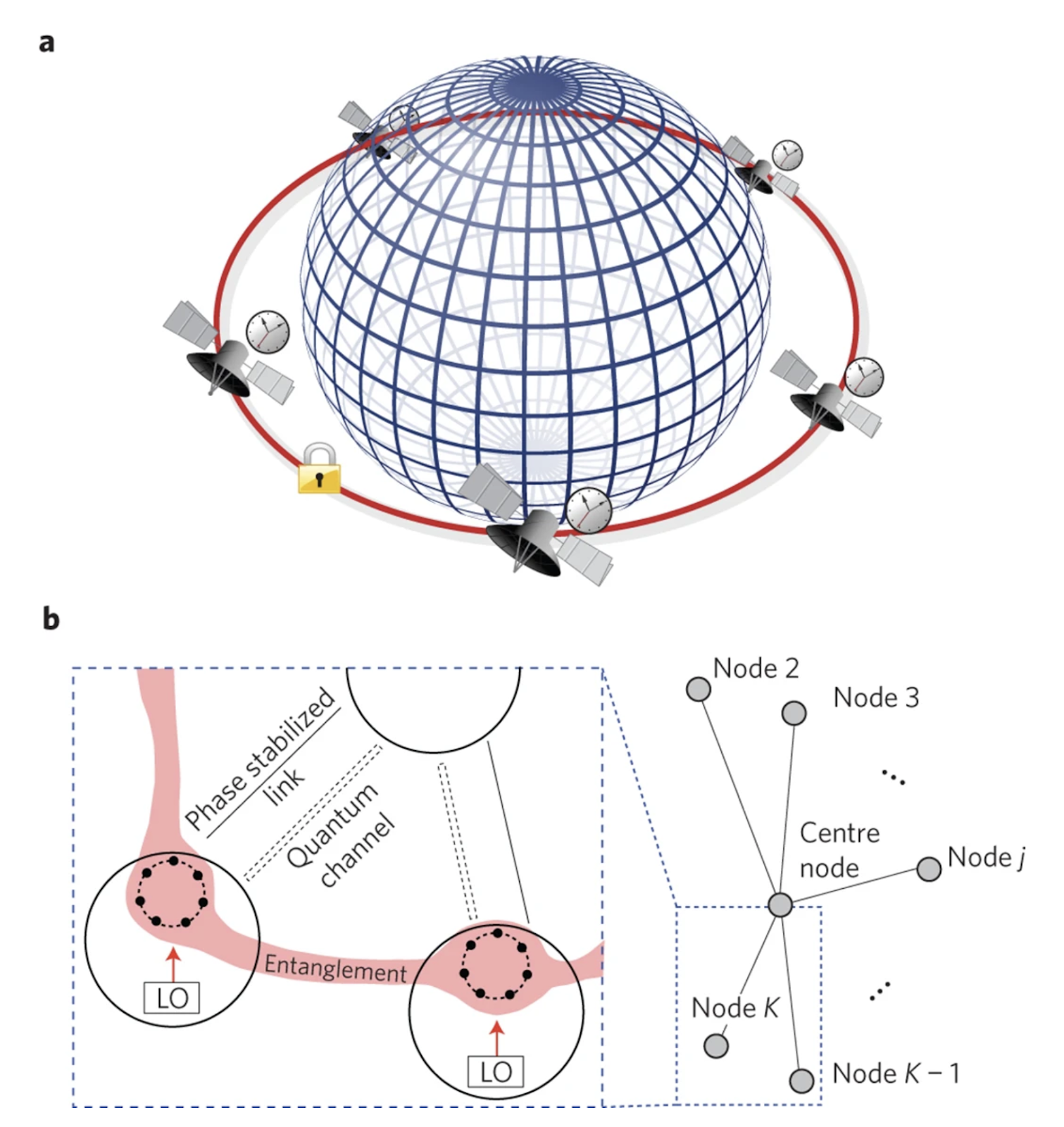
  • A Quantum Network of Clocks: Recent research shows that a quantum network of atomic clocks can result in a substantial boost of the overall precision if multiple clocks are properly connected by quantum mechanical means. Compared to a single clock, the ultimate precision will improve as much as 1/K, where K is the number of clocks. If the same clocks are connected via a classical network, the precision scales as much as 1/SQRT(K). Ultimately, a quantum network of atomic clocks can surpass the Standard Quantum Limit (SQL) to reach the ultimate precision allowed by quantum theory — the Heisenberg limit. See Figure 1b.
  • Upscaling Quantum Computing: An individual quantum computer is typically limited in size. Connected by quantum networks, multiple quantum computers can work together as one big quantum computer to address larger problems. See Figure 1c.
Diagram

Description automatically generated
Figure 1a: Secure quantum communication (credit: Chen et al. https://journals.aps.org/prl/abstract/10.1103/PhysRevLett.124.070501).Figure 1b: A quantum network of clocks (credit: Komar, Peter et al. “A quantum network of clocks.” Nature Physics 10.8 (2014:582-587).Figure 1c: Upscale quantum computing (credit: Thor Swift, Berkeley Lab).

Quantum Network Basics

Quantum networks are distributed systems of quantum systems, which are able to exchange quantum bits (qubits) and generate and distribute entangled quantum states. As illustrated by Figure 2, a quantum network conceptually consists of three essential quantum components: 

  1. Quantum nodes, which are physical quantum systems (e.g., trapped ions, quantum dots, Nitrogen-vacancy centers) connected to the quantum network. Well-characterized matter qubits are typically defined and created from these physical quantum systems. Quantum information is generated, processed, and stored locally by matter qubits in quantum nodes.  Matter qubits, often referred to as stationary qubits, are typically isolated from the surrounding environment to minimize decoherence and facilitate various quantum operations. 
  2. Quantum channels, which connect physically separated quantum components in the quantum network and transfer quantum states faithfully from place to place using the flying qubits. Optical fibers and free-space communications are typically implemented as quantum channels because they have a reduced chance of decoherence and loss. Photons with polarization or time-bin encoding are the flying qubit of choice. The implementation of quantum channels also requires that information encoded in a stationary qubit is reliably transferred to a flying qubit, and vice versa. 
  3. Quantum repeaters, which allow the end-to-end generation of quantum entanglement, and thus, the end-to-end transmission of qubits by using quantum teleportation. Quantum repeaters typically implement entanglement-related operations such as entanglement swapping and entanglement purification.

Figure 2: A quantum network consists of three essential quantum systems

In quantum networks, qubits cannot be copied due to the no-cloning theorem, which forbids the creation of identical copies of an arbitrary unknown quantum state. Therefore, qubits can not be physically transmitted over long distances without being hindered by the effects of signal loss and decoherence inherent to most transport mediums such as optical fiber. However, qubits can share a special relation known as entanglement. Entangled qubits have interesting non-local properties, even if they are located at distant nodes. Consuming an entangled qubit pair, a data qubit can be sent deterministically to a remote node. Entanglement is the fundamental building block of quantum networks. 

As illustrated in Figure 3, key entanglement-related operations include: 

  • Entanglement Purification: Multiple low-quality entanglements can be purified into a high-quality entanglement. 
  • Entanglement Swapping: Long-distance entanglement can be built from shorter segments, with flying qubits transmitted locally.
  • Teleportation: to enable the end-to-end transmission of qubits.

Figure 3: Key entanglement-related operations

Classic networks typically concern the performance metrics such as bandwidth, throughput, and latency. Likewise, quantum networks care for performance metrics related to quantum operations. Critical quantum quality metrics include entanglement generation rate, decoherence rate, and fidelity. In quantum networks, fidelity is a key indicator to characterize the quality of quantum states or operations. In general, a minimum fidelity (Fmin) is required to support quantum operations.

It is envisioned that quantum networks will operate in parallel with classic networks. Quantum networks are not meant to replace classic networks but rather to supplement them with quantum capabilities.

Current Status

Today, quantum networks are in their infancy. Like the Internet, quantum networks are expected to undergo different stages of research and development until they reach their full functionality. There are many promising R&D efforts underway looking to develop quantum network technologies. The DOE unveiled a quantum Internet blueprint in 2020 to accelerate research in quantum science and technology, with the emphasis on the creation of a quantum Internet.

Q&A with Jessy Schmit, ESnet’s Network Engineering Group Lead!

Jessy Schmit came to ESnet from Pilot Fiber in New York, NY, where for the last six years, she was the Senior Manager of Network Operations and Support. Before Pilot Fiber, Jessy worked at a creative advertising agency and spent several years in the arts as a performer and director. Her background includes strategic leadership in marketing, customer experience, design, and technology. 

Schmit recently earned her Master’s Degree in Technology Management from New York University’s Tandon School of Engineering. 

Originally from Seattle, she currently resides in Brooklyn and spent seven years in the San Francisco Bay Area getting her undergraduate degree. She looks forward to reconnecting with her West Coast roots at ESnet.  

Question 1: What brought you to ESnet?

I had the opportunity to work with Jay Stewart at my last company, his recommendation and an instant connection to the people I met during the interview process made the decision a no-brainer.  ESnet’s mission and values are something I can really get behind!

Question 2: What is the most exciting thing in your field right now?

I nerd out on customer experience and process improvements, so I am excited about the modernization of IT back office, technical support, and self-service for engineering organizations. Increasing automation strategically without sacrificing the beneficial human elements of customer and end-user support can speed execution and ease the burden on engineering and support teams. Network automations can also reduce error and improve availability and resilience. In other sectors, specifically healthcare, we’re seeing how self-service, increased resiliency and the improved application of technology can make people feel more connected to their provider or service.  

Question 3: What excites you most about your role?

The people! The candid and thoughtful approach to questions and discussion was really refreshing during my interview process. And now I have the opportunity to work beside those totally awesome ESnet folks everyday and they’ve surpassed my expectations. I am excited to continue collaborating with such a talented and dedicated team of performers across the organization and learning all I can in my new environment. Working to further such a worthy mission makes it pretty easy to feel passionate about my new job.

Question 4: What challenges/opportunities are you looking forward to tackling?

I’m excited to figure out what motivates my team. I’ve found that what drives an engineer is wildly different from what motivates an accountant or a professor or chef (or any other role). Creating an environment where everyone feels supported and enabled to perform exemplary work that betters the larger organizational goals but also, ideally, their own development goals, is a focus for me.  

Question 5: How do you feel your past experience will transfer to your role at ESnet?

Looking at the typical pedigree of a team lead in technology or science, the benefits of a background in the arts might not be immediately obvious. While traditional technical skills may get a candidate in the door, it’s really the interpersonal and communication skills that allow them to thrive in their role. Entering the realm of technology and science from another discipline provides me with a unique perspective that can add diversity to the viewpoints of the team. My previous role was at a startup ISP in Manhattan and the pace of progress on our network operations and engineering meant I had to be agile, speedy, creative, and responsive – around the clock – to emergencies and customer needs. I’m hopeful the transfer of my work ethic, adaptability, and empathy will allow me to provide individualized support for my team(s) and future customers. 

Question 6: What book, movie, or podcast would you recommend?

I could talk about movies for days, but I’d say “KIMI” for a little tech industry suspense. I would also recommend “The Woman King” for some stellar performances and an inspiring story, and “Severance” (TV show) for a fascinating, and sometimes super funny, dystopian drama.

Join ESnet at SC22!

The International Conference for High Performance Computing, Networking, Storage, and Analysis (SC22) is just around the corner and ESnet staff will be there to connect, learn, and share their knowledge with the HPC community. SC22 will take place November 13 – 18 in Dallas, Texas, and is primarily in person for the first time since 2019. 

Here are some staff highlights:

Sunday, November 13

  • 8:30 AM – 5:00 PM  INDIS 2022: Annual International Workshop on Innovating the Network for Data-Intensive Science, Mariam Kiran, Anu Mercian, Room C156 
  • 8:55 AM     INDIS 2022: Panel Discussion: Network Research Exhibition: the Future of Networking and Computing with Big Data Streams, Tom Lehman, C
  • 3:30 PM     INDIS 2022 Featured Technical Talk: Quantum Communication: A Physics Experiment of a Network Paradigm Shift, Inder Monga, Room C156
  • 4:10 PM     Paper: EJ-FAT Joint ESnet JLab FPGA Accelerated Transport Load Balancer, Stacey Sheldon, Yatish Kumar, Michael Goodrich, Graham Heyes, Room C156  

Tuesday, November 15

  • 10:30 AM – 12:00 PM    Paper: HPC Network Architecture, Mariam Kiran, Room C141-143-149
  • 12:00 PM – 1:00 PM    Demo: Global Petascale to Exascale Workflows for Data Intensive Science, Mariam Kiran, DOE Booth #1600
  • 3:15 PM    Featured DOE Booth Talk: ESnet6: How ESnet’s Next-Generation Infrastructure Will Enable Integrated Research Initiative Workflows, Inder Monga, DOE Booth #1600

Wednesday, November 16

  • 11:00 AM    SC22 Network Research Exhibition, SC22-NRE-15, SENSE and Rucio/FTS/XRootD Interoperation, Tom Lehman, Xi Yang, Caltech Booth #2820
  • 2:00 PM    SC22 Network Research Exhibition, SC22-NRE-13, AutoGOLE/SENSE: End-to-End Network Services and Workflow Integration, Tom Lehman, Xi Yang, Caltech Booth #2820

Thursday, November 17

  • 10:00 AM     Demo: Janus Container Management and the EScp Data Mover, Ezra Kissel, Charles Shiflett, Md Arrifuzzaman, DOE Booth #1600

Under Budget and Ahead of Schedule, ESnet6 Project Receives Final CD-4 Approval

The Department of Energy’s Office of Project Assessment recently issued its final CD-4 Review Report on the Energy Sciences Network (ESnet)’s ESnet6 upgrade project. The review, held on July 12 – 13, 2022, and conducted at the request of Barbara Helland, Associate Director of Science for Advanced Scientific Computing Research (ASCR), assessed the project’s readiness to proceed to the approval of project completion. The project completed all threshold key performance parameters (KPPs) six months ahead of the early finish date, two years ahead of the CD-4 Level 1 milestone date, and well under budget. The committee assessed that the project was ready to proceed to CD-4 approval, which was achieved on July 29, 2022. The Final Closeout report and Lessons Learned are being submitted next week within the specified 90-day window.

“I want to congratulate the entire ESnet organization especially the ESnet6 project director, Kate Mace, and the project team,” said Inder Monga, executive director of ESnet. “When the team set out to deliver on a project scope as vast as the ESnet6 launch, we did not imagine a global pandemic would interrupt the process. Despite that, the team delivered the entire project ahead of the deadline and, even with supply-chain issues, managed to complete the scope below the projected budget. Most of the team attended the ESnet6 Unveiling Event on October 11 and heard their accomplishments praised by the lab directorate as well as congresspeople and DOE staff.”

The committee commended the project team for their “unique and innovative approach” in completing the project objectives and complimented ESnet for their agility in following through with the project scope while dealing with the difficult environment generated by the COVID-19 pandemic. The report stated that COVID-19 restrictions, limitations, and supply-chain issues presented “no significant impact” on the project’s critical path. The report also identified the distributed nature of operations and ESnet’s support for a remote workforce as an “invaluable” approach and a best practice to be shared beyond the DOE complex.

The final reports required for the official Project Closeout will be submitted to DOE this week. The ESnet team has continued to keep up the pace as they work toward additional enhancements to the ESnet6 Facility. “The #ESnet6Week festivities the week of October 9 energized the team. Not only were the project accomplishments celebrated at the ESnet6 Unveiling event, but the team also heard firsthand about the impact the project has already had on scientific discovery,” said Kathryn Mace, the ESnet6 project director, and Network Engineering group lead. “Hearing about the expansion of scientific collaborations made easier with the ESnet6 network and automated operations provided the team with newfound motivation to keep moving full speed ahead. ESnet6 sets the foundation for global scientific innovation over the next 10 years.”

The ESnet6 project team, DOE staff, IPR Committee, and members of the Berkeley Lab directorate during the final CD-4 IPR closeout session.

ESnet6 Unveiled Tomorrow!

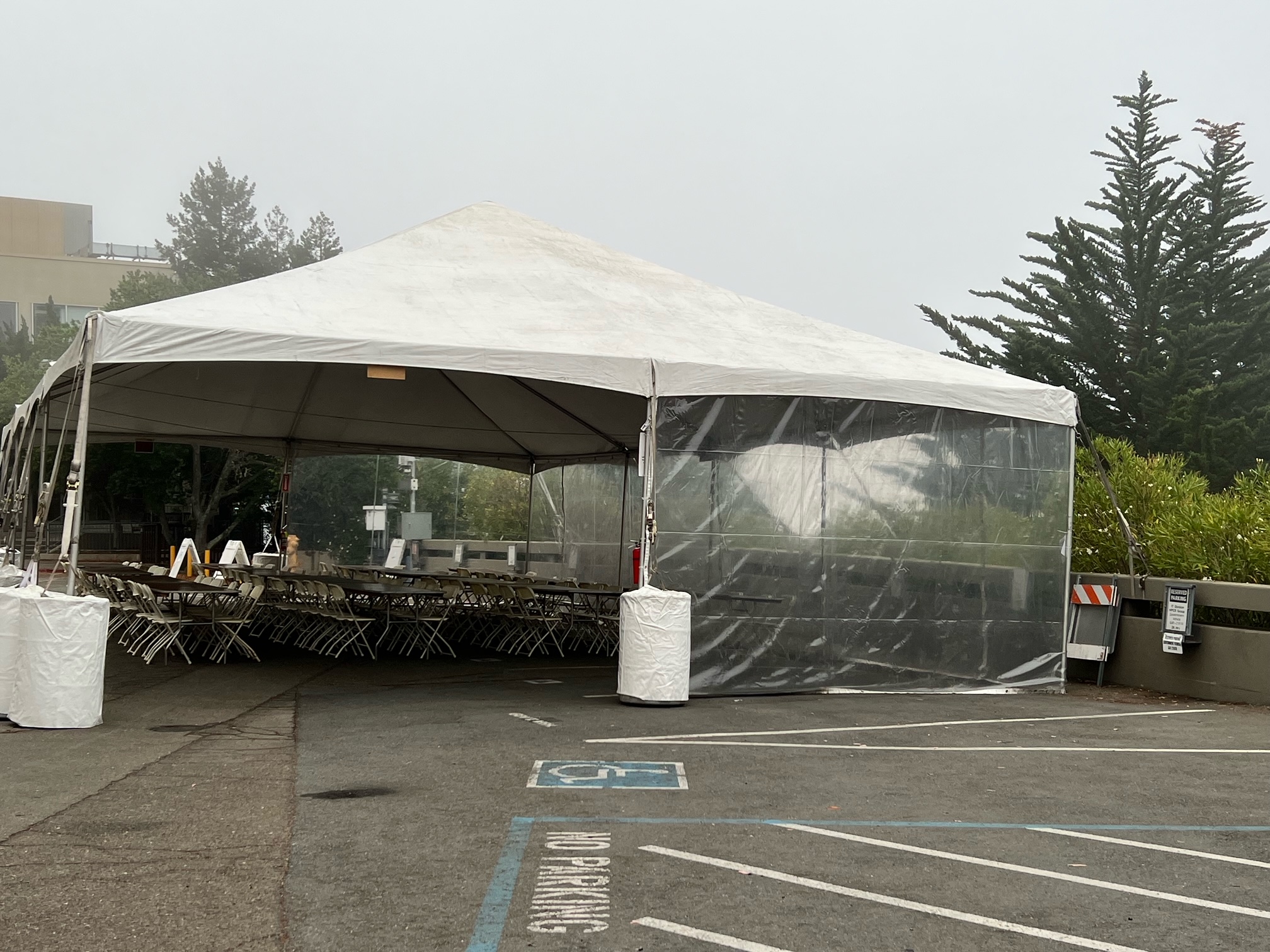
We’re getting things set up for the ESnet6 Unveiling tomorrow – our tent has gone up, we’re holding final rehearsals for the presentations, printing badges, and doing a thousand other small things.  

The only thing missing from our pictures is you! 

See you tomorrow for the big day, if you are visiting in person, travel safe, and if you are joining us virtually, the show starts at 9:00 AM on https://streaming.lbl.gov.

Why We Designed and Deployed ESnet6: It is All About the Science!

We’re just a few days away from the ESnet6 unveiling and Confab22!

Here’s a great video interview with Ann Almgren, Senior Scientist in CCSE and the Department Head of the Applied Mathematics Department in the Applied Mathematics and Computational Research Division at Berkeley Lab. In it she discusses her research into wind power generation/distribution, and how she will use ESnet6.

Ann Almgren, Berkeley Lab

To watch the unveiling of ESnet6 and learn more about Ann’s research, join us 11 October from 900AM – 12 PM PT at streaming.lbl.gov!