Sheng Shen, Mariam Kiran, and Bashir Mohammed have just been awarded the Best Paper award at the International Conference on Machine Learning for Networking (MLN). Sponsored by the Conservatoire National des Arts et Métiers (CNAM), the École Supérieure d’Ingénieurs en Électrotechnique et Électronique (ESIEE), and Laboratoire d’Informatique Gaspard-Monge (LIGM), MLN is being held virtually 1-3 December 2021.
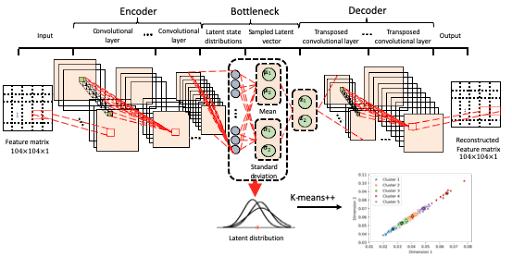
The paper, “DynamicDeepFlow: An Approach for Identifying Changes in Network Traffic Flow Using Unsupervised Clustering,” uses a hybrid of deep learning variational autoencoder model and a shallow learning k-means to help identify unique traffic patterns across ESnet. These unique patterns can help identify if a new experiment has started or whether current network bandwidth is changing.
DynamicDeepFlow (DDF) model structure
“We’re very excited to receive this recognition and the conference was a wonderful opportunity to exchange thoughts and ideas with peers in France. MLN is a conference dedicated to discussing machine learning applications in networks. Our next task is to integrate DynamicDeepflow with Netpredict to show real-time information in ESnet data” — Mariam Kiran
Papers from MLN will be published as post-proceedings in Springer’s Lecture Notes in Computer Science (LNCS).
Scott Campbell presented “ESnet Security Group Impact on Network Architecture” where he discussed some of the social, technical, and architectural outcomes of the ESnet6 network upgrade that were beneficial to the organization. By being involved early, security design elements were incorporated into workflows at early stages and were both tightly integrated and vetted during the core design process. This early involvement also heightened the security group’s visibility, which led to a better understanding of how the various groups interact and their different methods of problem-solving and time management.
Eli Dart and Fatema Bannat Wala presented “Best practices for securing Science DMZ,” focusing on disentangling security policies and enforcement for science flows from traditional security approaches for business systems, and use of the Science DMZ model to protect high-performance science flows. They discussed thinking of the Science DMZ as a security architecture that provides useful and implementable security controls without impacting performance.
A combined team from ESnet and Lehigh University was awarded the best paper for Exploring the BBRv2 Congestion Control Algorithm for use on Data Transfer Nodes at the 8th IEEE/ACM International Workshop on Innovating the Network for Data-Intensive Science (INDIS 2021), which was held in conjunction with the 2021 IEEE/ACM International Conference for High Performance Computing, Networking, Storage and Analysis (SC21) on Monday, November 15, 2021.
The team was comprised of:
Brian Tierney, Energy Sciences Network (ESnet)
Eli Dart, Energy Sciences Network (ESnet)
Ezra Kissel, Energy Sciences Network (ESnet)
Eashan Adhikarla, Lehigh University
The paper can be found here. Slides from the presentation are here. In this Q+A, ESnet spoke with the award-winning team about their research — answers are from the team as a whole.
The paper is based on extensive testing and controlled experiments with the BBR (Bottleneck Bandwidth and Round-trip propagation time), BBRv2 and the Cubic Function Binary Increase Congestion Control (CUBIC) Transmission Control Protocol (TCP) Internet congestion algorithms. What was the biggest lesson from this testing?
BBRv2 represents a fundamentally different approach to TCP congestion control. CUBIC (as well as Hamilton, Reno, and many others) are loss-based, meaning that they interpret packet loss as congestion and therefore require significant network engineering effort to achieve high performance. BBRv2 is different in that it measures the network path and builds a model of the path – it then paces itself to avoid loss and queueing. In practical terms, this means that BBRv2 is resilient to packet loss in a way that CUBIC is not. This comes through loud and clear in our data.
What part of the testing was the most difficult and/or interesting?
We ran a large number of tests in a wide range of scenarios. It can be difficult to keep track of all the test configurations, so we wrote a “test harness” in python that allowed us to keep track of all the testing parameters and resulting data sets.
The harness also allowed us to better compare results collected over real-world paths to those in our testbed environments. Managing the deployment of the testing environment though containers also allowed for rapid setup and improved reproducibility.
You provide readers with links to great resources so they can do their own testing and learn more about BBRv2. What do you hope readers will learn?
We hope others will test BBRv2 in high-performance research and education environments. There are still some things that we don’t fully understand, for example there are some cases where CUBIC outperforms BBRv2 on paths with very large buffers. It would be great for this to be better characterized, especially in R&E network environments.
What’s the next step for ESnet research into BBRv2? How will you top things next year?
We want to further explore how well BBRv2 performs at 100G and 400G. We would also like to spend additional time performing a deeper analysis of the current (and newly generated) results to gain insights into how BBRv2 performs compared to other algorithms across varied networking infrastructure. Ideally we would like to provide strongly substantiated recommendations on where it makes sense to deploy BBRv2 in the context of research and educational network applications.
As part of a team spanning 15 government, academic, and industrial partners, the Engagement and Performance Operations Center (EPOC) – a collaboration between Indiana University and ESnet – was awarded the “Best HPC Collaboration (Academia/Government/Industry)” HPCwire Readers’ Choice award on Tuesday, Nov. 16. The award, which was made at the High Performance Computing, Networking, Storage and Analysis (SC21) conference, recognizes the effort and collaboration required to move and safeguard irreplaceable data (over 50 years of astronomical observations) from the Arecibo observatory following the structural collapse of this scientific resource in 2016.
At ESnet, Ken Miller, George Robb, and Jason Zurawski supported these efforts as both full members of EPOC and ESnet staff. Both Jason and Ken divide their time between ESnet’s Science Engagement Team, while George is with ESnet’s Infrastructure Systems group. LightBytes looped up with Jason Zurawski to get his thoughts on the project and award, and an update on the Arecibo effort since our post in April 2021 on this project.
Now that data from Arecibo has been migrated to the Texas Advanced Computing Center (TACC), what happens now, and how will this data be used?
The team at the University of Central Florida has been engaged with TACC on several ways to build up the capabilities for their data analysis and sharing requirements. They are working to deploy a portal that will allow researchers access to the data, as well as build workflows to investigate and process using computation provided by TACC.
The team at Arecibo is also still going to process much older data that still resides on tape. Due to the delicate state of the media, it is carefully being read and transferred to on-island storage before being transmitted to TACC for archiving. This work will take several more months to complete.
What do you think the lessons from this effort are in terms of getting so many different organizations to work together to support this very challenging problem?
The collapse that Arecibo experienced sent ripples through the R&E community because researchers and technology professionals alike knew there was a limited window to act on replicating important observations gathered over the years. The partners in this effort were motivated to act, and that removed many barriers to putting some solutions in place. Everyone collaborated efficiently with their core competencies, and we continue to work together as the next steps for the scientific collaboration are planned.
Plans are starting to emerge for a “next generation” Arecibo based on the loss of this instrument, how might the next generation of data management resources be shaped by this collaboration?
Now that there has been some time to evaluate the work, it has also spurred UCF and Arecibo to plan for the future with respect to computation, storage, and network connectivity both in Puerto Rico and in Florida. With these improvements planned, they will be well-positioned to serve the scientific data for years to come. New instruments will no doubt increase the data demands by many orders of magnitude – addressing all aspects of the data pipeline now, and then gradually increasing the capabilities over time, will help to prepare for these emerging challenges.
Congratulations to all of the organizations and staff who helped prevent the loss of this data!
Advancing our strategy and shaping our position on the board. Some thoughts from Inder on the year-that-was.
Miniature from Alfonso X’sLibro del axedrez dados et tablas (Book of chess, dices and tables), c. 1283. , Public domain, via Wikimedia Commons
Dear Friends, Well-wishers, Colleagues, and all of ESnet,
Chess! 2020 has been much more challenging than this game. It’s also been a year where we communicated through the squares on our zoom screens, filled with faces of our colleagues, collaborators, and loved ones.
In January, Research and Education leaders came together in Hawaii at the Pacific Telecommunications Council meeting to discuss the future of networking across the oceans. It was impossible to imagine then that we would not be able to see each other again for such a long time. Though thanks to those underwater cables, we have been able to communicate seamlessly across the globe.
Looking back at 2020, we not only established a solid midgame position on our ESnet chessboard, but succeeded in ‘winning positions’ despite the profound challenges. The ESnet team successfully moved our network operations to be fully remote (and 24/7) and accomplished several strategic priorities.
ESnet played some really interesting gambits this year:
Tackled COVID-related network growth and teleworking issues for the DOE complex
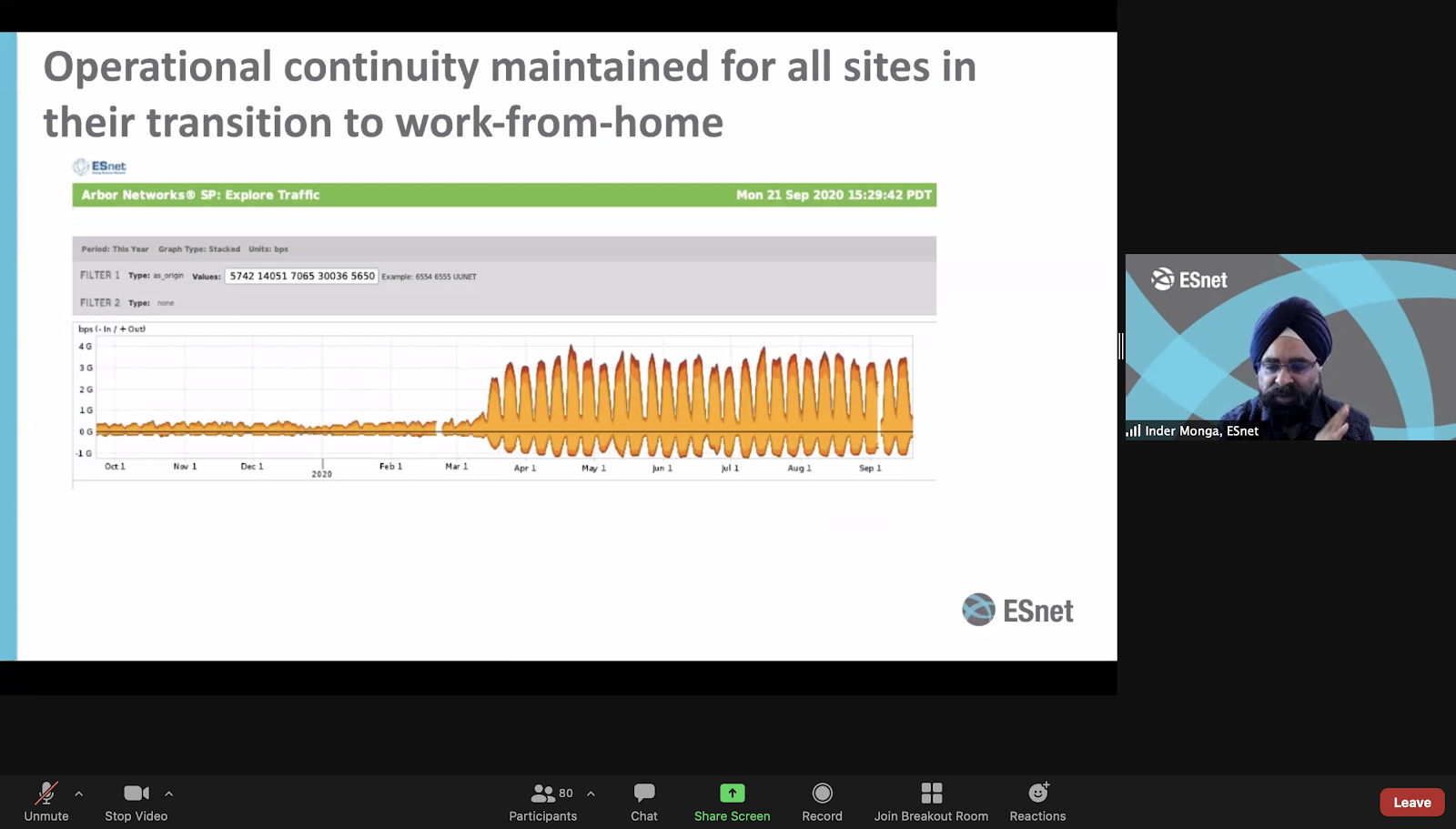
We saw a 4x spike in remote traffic and worked closely across several Labs to upgrade their connectivity. We continue to address the ever-growing demand in a timely manner.
As we all shifted to telework from home, ESnet engineers developed an impromptu guide that was valuable to troubleshoot our home connectivity issues.
Progressed greatly on implementing our next-generation network, ESnet6
We deployed and transitioned to the ESnet6 optical backbone network, with 300 new site installations, 100’s of 100G waves provisioned, with just six months of effort, and while following pandemic safety constraints. I am grateful to our partners Infinera (Carahsoft) and Lumen for working with our engineers to make this happen. Check out below how we decommissioned the ESnet5 optical network and lit up the ESnet6 network.
Installed a brand new management network and security infrastructure upgrades along with significant performance improvements.
We awarded the new ESnet6 router RFP (Congratulations Nokia and IMPRES!); the installs start soon.
Issued another RFP for optical transponders, and will announce the winner shortly.
Took initiative on several science collaborations to address current and future networking needs
We brainstormed new approaches with the Rubin Observatory project team, Amlight, DOE and NSF program managers to meet the performance and security goals for traffic originating in Chile. We moved across several countries in South America before reaching the continental U.S. in Florida (Amlight), and eventually the U.S. Data Facility at SLAC via ESnet.
Drew insights through deep engagement of ESnet engineers with the High Energy Physics program physicists, for serving the data needs of their current and planned experiments expediently. Due to the pandemic, a two-day immersive in-person meeting turned into a multi-week series of Zoom meetings, breakouts, and discussions.
When an instrument produces tons of data, how do you build the data pipeline reliably? ESnet engineers took on this challenge, and worked closely with the GRETA team to define and develop the networking architecture and data movement design for this instrument. This contributed to a successful CD 2/3 review of the project—a challenging enough milestone during normal times, and particularly tough when done remotely.
Exciting opening positions were created with EMSL, FRIB, DUNE/SURF, LCLS-II…these games are still in progress, more will be shared soon.
Innovated to build a strong technology portfolio with a series of inspired moves
We demonstrated Netpredict, a tool using deep learning models and real-time traffic statistics to predict when and where the network will be congested. Mariam’s web page showcases some of the other exciting investigations in progress.
Richard and his collaborators published Real-time flow classification by applying AI/ML to detailed network telemetry.
High-touch ESnet6 project
Ever dream of having the ability to look at every packet, a “packetscope”, at your fingertips? An ability to create new ways to troubleshoot, performance engineer, and gain application insights? We demonstrated a working prototype of that vision at the SC20 XNET workshop.
SENSE
We deployed a beta version of software that provides science applications the ability to orchestrate large data flows across administrative domains securely. What started as a small research project five years ago (Thanks ASCR!) is now part of the AutoGOLE project initiative in addition to being used for Exascale Computing Project (ECP) project, ExaFEL.
TCP
Initiated the Q-Factor project this year, a research collaboration with Amlight, funded by NSF. The project will enable ultra-high-speed data transfer optimization by TCP parameter tuning through the use of programmable dataplane telemetry: https://q-factor.io/
We testbed thoroughly the interactions between TCP congestion control algorithms, BBRv2 and CUBIC. A detailed conversation with Google, the authors of the BBRv2 implementation, is in progress.
Initiated strategic new games, with a high potential for impact
Executed on the vision and design of a nationwide @scale research testbed working alongside a superstar multi-university team.
With the new FAB grant, FABRIC went international with plans to put nodes in Bristol, Amsterdam, Tokyo and Geneva. More locations and partners are possibilities for the future.
Edge Computing
Created an prototype FPGA-based edge-computing platform for data-intensive science instruments in collaboration with the Computational Research Division and Xilinx. Look for exciting news on the blog as we complete the prototype deployment of this platform.
Quantum
We helped organize the Quantum Networking Blueprint workshop in February this year, articulating priority research areas needed to capture the Quantum Repeater grand challenge.
5G
What are the benefits of widespread deployment of 5G technology on science research? We contributed to the development of this important vision at a DOE workshop. New and exciting pilots are emerging that will change the game on how science is conducted. Stay tuned.
Growth certainly has its challenges. But, as we grew, we evolved from our old game into an adept new playing style. I am thankful for the trust that all of you placed in ESnet leadership, vital for our numerous, parallel successes. Our 2020 reminds me of the scene in Queen’s Gambit where the young Beth Harmon played all the members of a high-school chess team at the same time.
Several achievements could not make it to this blog, but are important pieces on the ESnet chess board. They required immense support from all parts of ESnet, CS Area staff, Lab procurement, Finance, HR, IT, Facilities, and Communications partners.
I am especially grateful to the DOE Office of Science, Advanced Scientific Computing Research leadership, NSF, and our program manager Ben Brown, whose unwavering support has enabled us to adapt and execute swiftly despite blockades.
All this has only been possible due to the creativity, resolve, and resilience of ESnet staff — I am truly proud of each one of you. I am appreciative of the new hires that trusted their careers with us and joined us remotely—without shaking hands or even stepping foot at the lab.
My wish is for all to stay safe this holiday season, celebrate your successes, and enjoy that extra time with your immediate family. In 2021, I look forward to killer moves on the ESnet chessboard, while humanity checkmates the virus.
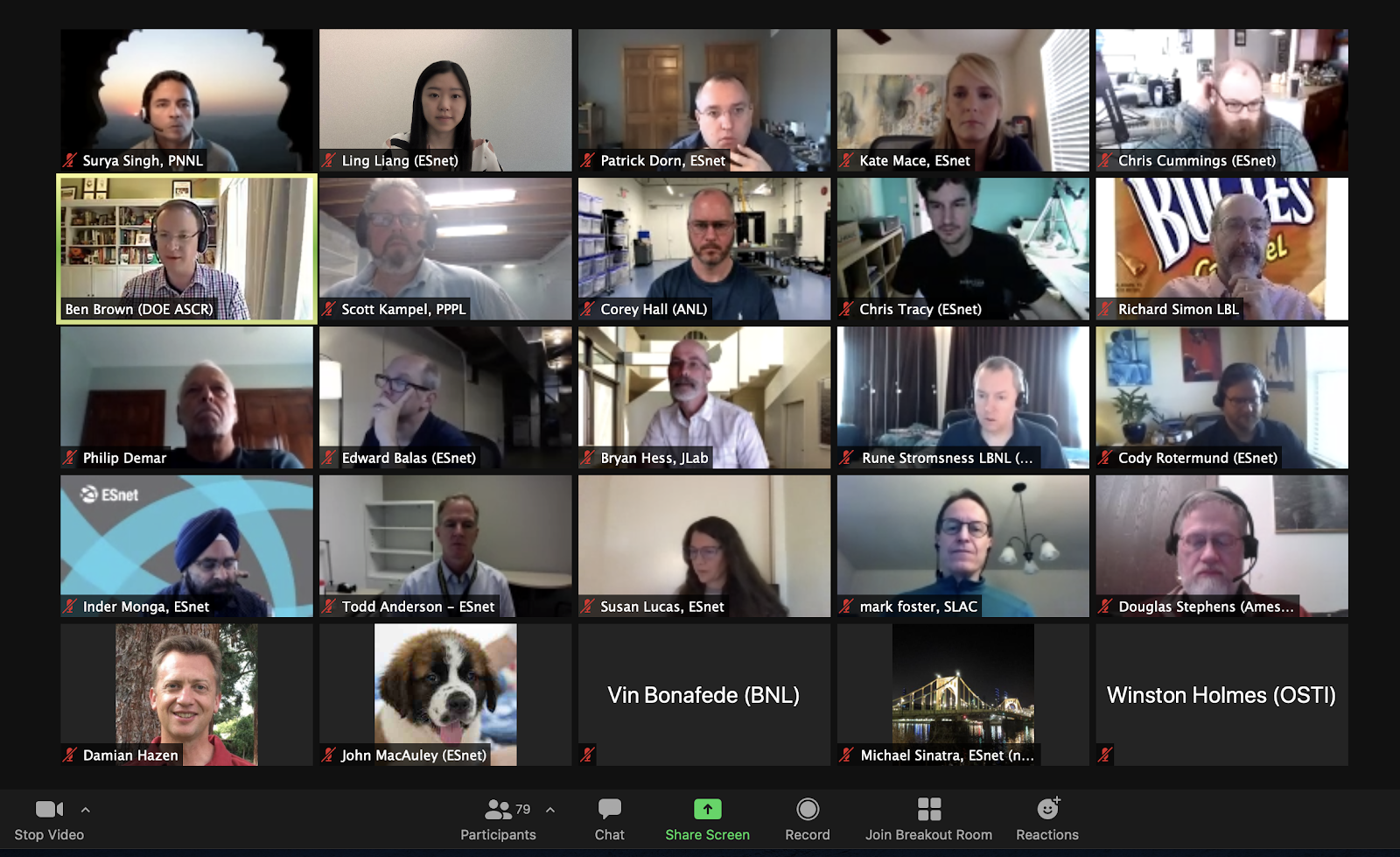
The ESnet Site Coordinating Committee (ESCC) meeting on 22-23 October was attended by over 50 members representing all of the major DOE sites and projects supported by our team. This was the first ESCC meeting held via Zoom.
The meeting focused on network resiliency, both on lessons learned from adapting to working from home, as well as longer term plans for ESnet6.
Highlights of the sessions were ESnet’s director Inder Monga’s presentation on the ways we ensured operational continuity during the pandemic.
Inder Monga presents on ESnet’s support for the DOE complex during the pandemic
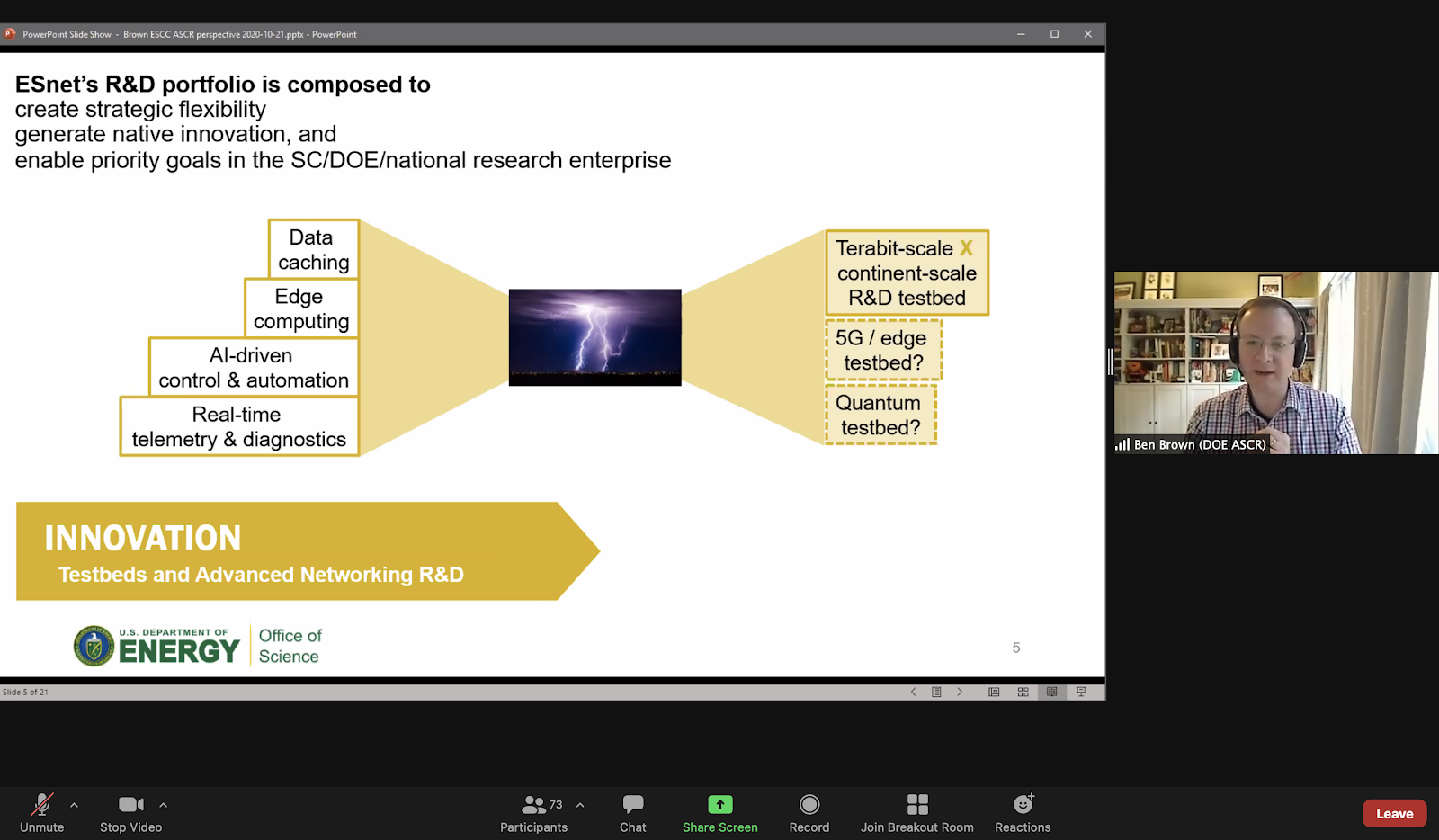
The DOE ESnet program manager, Ben Brown, provided a vision for future research opportunities as well as future operational needs for the nation’s scientific complex.
DOE’s Ben Brown presents on future objectives and priorities
Attendees identified several key activities for ESCC collaboration as part of advancing shared resilience goals. Foremost among these is the creation of a working group to develop improved metrics for ESnet resilience, to identify ways that resilience features can be better incorporated into infrastructure funding and planning, and to establish better ways to engage scientific programs into risk management processes.
ESnet thanks ESCC participants for attending and we look forward to returning to in-person ESCC meetings in future!
Created in 1986, the U.S. Department of Energy’s (DOE’s) Energy Sciences Network (ESnet) is a high-performance network built to support unclassified science research. ESnet connects more than 40 DOE research sites—including the entire National Laboratory system, supercomputing facilities and major scientific instruments—as well as hundreds of other science networks around the world and the Internet.
Step 4: Make it even faster with DUAL Satellite links! We’re talking 56 kilobits per second! Except for the Princeton fusion scientists – they get 112 Kbps! (1987)
Step 5: Whoa, when an upgrade to 1.5 MEGAbits per second isn’t enough, add ATM (not the money machine, but Asynchronous Transfer Mode) to get more bang for your buck. (1995)
Step 6: Duty now for the future—roll out the very first IPv6 address to ensure there will be enough Internet addresses for decades to come. (2000)
Step 7: Crank up the fastest links in the network to 10 GIGAbits per second—16 times faster than the old gear—a two-generation leap in network upgrades at one time. (2003)
Step 8: Work with other networks to develop really cool tools, like the perfSONAR toolkit for measuring and improving end-to-end network performance and OSCARS (On-Demand Secure Circuit and Advance Reservation), so you can reserve a high-speed, end-to-end connection to make sure your data is delivered on time. (2006)
Step 9: Why just rent fiber? Pick up your own dark fiber network at a bargain price for future expansion. In the meantime, boost your bandwidth to 100G for everyone. (2012)
Step 10: Here’s a cool idea, come up with a new network design so that scientists moving REALLY BIG DATASETS can safely avoid institutional firewalls, call it the Science DMZ, and get research moving faster at universities around the country. (2012)
Step 11: We’re all in this science thing together, so let’s build faster ties to Europe. ESnet adds three 100G lines (and a backup 40G link) to connect researchers in the U.S. and Europe. (2014)
Step 12: 100G is fast, but it’s time to get ready for 400G. To pave the way, ESnet installs a production 400G network between facilities in Berkeley and Oakland, Calif., and even provides a 400G testbed so network engineers can get up to speed on the technology. (2015)
Step 13: Celebrate 30 years as a research and education network leader, but keep looking forward to the next level. (2016)
Attending SC15? Get a Close-up Look at Virtualized Science DMZs as a Service
ESnet, NERSC and RENCI are pooling their expertise to demonstrate “Virtualized Science SMZs as a Service” at the SC15 conference being held Nov. 15-20 in Austin. They will be giving the demos at 2:30-3:30 p.m. Tuesday and Wednesday and 1:30-2:30 p.m. Thursday in the RENCI booth #181.
Here’s the background: Many campuses are installing ScienceDMZs to support efficient large-scale scientific data transfers. There’s a need to create custom configurations of ScienceDMZs for different groups on campus. Network function virtualization (NFV) combined with compute and storage virtualization enables a multi-tenant approach to deploying virtual ScienceDMZs. It makes it possible for campus IT or NREN organizations to quickly deploy well-tuned ScienceDMZ instances targeted at a particular collaboration or project. This demo shows a prototype implementation of ScienceDMZ-as-a-Service using ExoGENI racks (ExoGENI is part of NSF GENI federation of testbeds) deployed at StarLight facility in Chicago and at NERSC.
The virtual ScienceDMZs deployed on-demand in these racks use the SPOT software suite developed at Lawrence Berkeley National Laboratory to connect to a data source at Argonne National Lab and a compute cluster at NERSC to provide seamless end-to-end high-speed data transfers of data acquired from Argonne’s Advanced Photon Source (APS) to be processed at NERSC. The ExoGENI racks dynamically instantiate necessary compute virtual resources for ScienceDMZ functions and connect to each other on-demand using ESnet’s OSCARS and Internet2’s AL2S system.
The Naval Research Laboratory (NRL), in collaboration with the DOE’s Energy Sciences Network (ESnet), the International Center for Advanced Internet Research (iCAIR) at Northwestern University, the Center for Data Intensive Science (CDIS) at the University of Chicago, the Open Cloud Consortium (OCC) and significant industry support, have conducted a 100 gigabits per second (100G) remote I/O demonstration at the SC14 supercomputing conference in New Orleans, LA.
The remote I/O demonstration illustrates a pipelined distributed processing framework and software defined networking (SDN) between distant operating locations. The demonstration shows the capability to dynamically deploy a production quality 4K Ultra-High Definition Television (UHDTV) video workflow across a nationally distributed set of storage and computing resources that is relevant to emerging Department of Defense data processing challenges.
As science transitions from lab-oriented to a distributed computational and data-intensive activity, the research and education (R&E) networking community is tracking the growing data needs of scientists. Huge instruments like the Large Hadron Collider are being planned and built. These projects require global-scale collaborations and contributions from thousands of scientists, and as the data deluge from the instruments grows, even more scientists are interested in analyzing it for the next breakthrough discovery. Suffice it to say that even though worldwide video consumption on the Internet is driving a similar increase in commercial bandwidth, the scale, characteristics, and requirements of scientific data traffic is quite different.
And this is why ESnet got invited to Cisco Systems’ headquarters last week to talk about how we how we handle data as part of their regular Nerd Lunch talk series. What I found interesting although not surprising, was that with Cisco being a big evangelist of telepresence, more employees attended the talk from their desks than in person. This was a first for me and I came away with a new appreciation for the challenges of collaborating across distances.
From a speaker’s perspective, the lesson learnt by me was to brush up my acting skills. My usual preparations are to rehearse the difficult transitions and focus on remembering the few important points to make on every slide. When presenting, that slide presentation portion of my brain goes on auto-pilot, while my focus turns towards evaluating the impact on the audience. When speaking at a podium one can observe when someone in the audience opens a notebook to jot down a thought, when their attention drifts to email on the laptop in front of them, or when a puzzled look appears on the face of someone as they try to figure out the impact of the point I’m trying to make. But these visual cues go missing with a largely webcast audience, making it harder to know when to stop driving home a point or when to explain the point further to the audience. In the future, I’ll have to be better at keeping the talk interesting without the usual clues from my audience.
Maybe the next innovation in virtual-reality telepresence is just waiting to happen?
Notwithstanding the challenges of presenting to a remote audience, enabling remote collaboration is extremely important to ESnet. Audio, video and web collaboration is a key service offered by us to the DOE labs. ESnet employees use video extensively in our day-to-day operations. The “ESnet watercooler”, a 24×7 open video bridge, is used internally by our distributed workforce to discuss technical issues, as well as, to have ad-hoc meetings on topics of interest. As science goes increasingly global, scientists are also using this important ESnet service for their collaborations.
With my brief stint in front of a stage now over, it is back to ESnet and then on to the 100G invited panel/talk at IEEE ANTS conference in Mumbai. Wishing all of you a very Happy New Year!






You must be logged in to post a comment.