Q&A with Jessy Schmit, ESnet’s Network Engineering Group Lead!

Jessy Schmit came to ESnet from Pilot Fiber in New York, NY, where for the last six years, she was the Senior Manager of Network Operations and Support. Before Pilot Fiber, Jessy worked at a creative advertising agency and spent several years in the arts as a performer and director. Her background includes strategic leadership in marketing, customer experience, design, and technology. 

Schmit recently earned her Master’s Degree in Technology Management from New York University’s Tandon School of Engineering. 

Originally from Seattle, she currently resides in Brooklyn and spent seven years in the San Francisco Bay Area getting her undergraduate degree. She looks forward to reconnecting with her West Coast roots at ESnet.  

Question 1: What brought you to ESnet?

I had the opportunity to work with Jay Stewart at my last company, his recommendation and an instant connection to the people I met during the interview process made the decision a no-brainer.  ESnet’s mission and values are something I can really get behind!

Question 2: What is the most exciting thing in your field right now?

I nerd out on customer experience and process improvements, so I am excited about the modernization of IT back office, technical support, and self-service for engineering organizations. Increasing automation strategically without sacrificing the beneficial human elements of customer and end-user support can speed execution and ease the burden on engineering and support teams. Network automations can also reduce error and improve availability and resilience. In other sectors, specifically healthcare, we’re seeing how self-service, increased resiliency and the improved application of technology can make people feel more connected to their provider or service.  

Question 3: What excites you most about your role?

The people! The candid and thoughtful approach to questions and discussion was really refreshing during my interview process. And now I have the opportunity to work beside those totally awesome ESnet folks everyday and they’ve surpassed my expectations. I am excited to continue collaborating with such a talented and dedicated team of performers across the organization and learning all I can in my new environment. Working to further such a worthy mission makes it pretty easy to feel passionate about my new job.

Question 4: What challenges/opportunities are you looking forward to tackling?

I’m excited to figure out what motivates my team. I’ve found that what drives an engineer is wildly different from what motivates an accountant or a professor or chef (or any other role). Creating an environment where everyone feels supported and enabled to perform exemplary work that betters the larger organizational goals but also, ideally, their own development goals, is a focus for me.  

Question 5: How do you feel your past experience will transfer to your role at ESnet?

Looking at the typical pedigree of a team lead in technology or science, the benefits of a background in the arts might not be immediately obvious. While traditional technical skills may get a candidate in the door, it’s really the interpersonal and communication skills that allow them to thrive in their role. Entering the realm of technology and science from another discipline provides me with a unique perspective that can add diversity to the viewpoints of the team. My previous role was at a startup ISP in Manhattan and the pace of progress on our network operations and engineering meant I had to be agile, speedy, creative, and responsive – around the clock – to emergencies and customer needs. I’m hopeful the transfer of my work ethic, adaptability, and empathy will allow me to provide individualized support for my team(s) and future customers. 

Question 6: What book, movie, or podcast would you recommend?

I could talk about movies for days, but I’d say “KIMI” for a little tech industry suspense. I would also recommend “The Woman King” for some stellar performances and an inspiring story, and “Severance” (TV show) for a fascinating, and sometimes super funny, dystopian drama.

Join ESnet at SC22!

The International Conference for High Performance Computing, Networking, Storage, and Analysis (SC22) is just around the corner and ESnet staff will be there to connect, learn, and share their knowledge with the HPC community. SC22 will take place November 13 – 18 in Dallas, Texas, and is primarily in person for the first time since 2019. 

Here are some staff highlights:

Sunday, November 13

  • 8:30 AM – 5:00 PM  INDIS 2022: Annual International Workshop on Innovating the Network for Data-Intensive Science, Mariam Kiran, Anu Mercian, Room C156 
  • 8:55 AM     INDIS 2022: Panel Discussion: Network Research Exhibition: the Future of Networking and Computing with Big Data Streams, Tom Lehman, C
  • 3:30 PM     INDIS 2022 Featured Technical Talk: Quantum Communication: A Physics Experiment of a Network Paradigm Shift, Inder Monga, Room C156
  • 4:10 PM     Paper: EJ-FAT Joint ESnet JLab FPGA Accelerated Transport Load Balancer, Stacey Sheldon, Yatish Kumar, Michael Goodrich, Graham Heyes, Room C156  

Tuesday, November 15

  • 10:30 AM – 12:00 PM    Paper: HPC Network Architecture, Mariam Kiran, Room C141-143-149
  • 12:00 PM – 1:00 PM    Demo: Global Petascale to Exascale Workflows for Data Intensive Science, Mariam Kiran, DOE Booth #1600
  • 3:15 PM    Featured DOE Booth Talk: ESnet6: How ESnet’s Next-Generation Infrastructure Will Enable Integrated Research Initiative Workflows, Inder Monga, DOE Booth #1600

Wednesday, November 16

  • 11:00 AM    SC22 Network Research Exhibition, SC22-NRE-15, SENSE and Rucio/FTS/XRootD Interoperation, Tom Lehman, Xi Yang, Caltech Booth #2820
  • 2:00 PM    SC22 Network Research Exhibition, SC22-NRE-13, AutoGOLE/SENSE: End-to-End Network Services and Workflow Integration, Tom Lehman, Xi Yang, Caltech Booth #2820

Thursday, November 17

  • 10:00 AM     Demo: Janus Container Management and the EScp Data Mover, Ezra Kissel, Charles Shiflett, Md Arrifuzzaman, DOE Booth #1600

Under Budget and Ahead of Schedule, ESnet6 Project Receives Final CD-4 Approval

The Department of Energy’s Office of Project Assessment recently issued its final CD-4 Review Report on the Energy Sciences Network (ESnet)’s ESnet6 upgrade project. The review, held on July 12 – 13, 2022, and conducted at the request of Barbara Helland, Associate Director of Science for Advanced Scientific Computing Research (ASCR), assessed the project’s readiness to proceed to the approval of project completion. The project completed all threshold key performance parameters (KPPs) six months ahead of the early finish date, two years ahead of the CD-4 Level 1 milestone date, and well under budget. The committee assessed that the project was ready to proceed to CD-4 approval, which was achieved on July 29, 2022. The Final Closeout report and Lessons Learned are being submitted next week within the specified 90-day window.

“I want to congratulate the entire ESnet organization especially the ESnet6 project director, Kate Mace, and the project team,” said Inder Monga, executive director of ESnet. “When the team set out to deliver on a project scope as vast as the ESnet6 launch, we did not imagine a global pandemic would interrupt the process. Despite that, the team delivered the entire project ahead of the deadline and, even with supply-chain issues, managed to complete the scope below the projected budget. Most of the team attended the ESnet6 Unveiling Event on October 11 and heard their accomplishments praised by the lab directorate as well as congresspeople and DOE staff.”

The committee commended the project team for their “unique and innovative approach” in completing the project objectives and complimented ESnet for their agility in following through with the project scope while dealing with the difficult environment generated by the COVID-19 pandemic. The report stated that COVID-19 restrictions, limitations, and supply-chain issues presented “no significant impact” on the project’s critical path. The report also identified the distributed nature of operations and ESnet’s support for a remote workforce as an “invaluable” approach and a best practice to be shared beyond the DOE complex.

The final reports required for the official Project Closeout will be submitted to DOE this week. The ESnet team has continued to keep up the pace as they work toward additional enhancements to the ESnet6 Facility. “The #ESnet6Week festivities the week of October 9 energized the team. Not only were the project accomplishments celebrated at the ESnet6 Unveiling event, but the team also heard firsthand about the impact the project has already had on scientific discovery,” said Kathryn Mace, the ESnet6 project director, and Network Engineering group lead. “Hearing about the expansion of scientific collaborations made easier with the ESnet6 network and automated operations provided the team with newfound motivation to keep moving full speed ahead. ESnet6 sets the foundation for global scientific innovation over the next 10 years.”

The ESnet6 project team, DOE staff, IPR Committee, and members of the Berkeley Lab directorate during the final CD-4 IPR closeout session.

ESnet6 Unveiled Tomorrow!

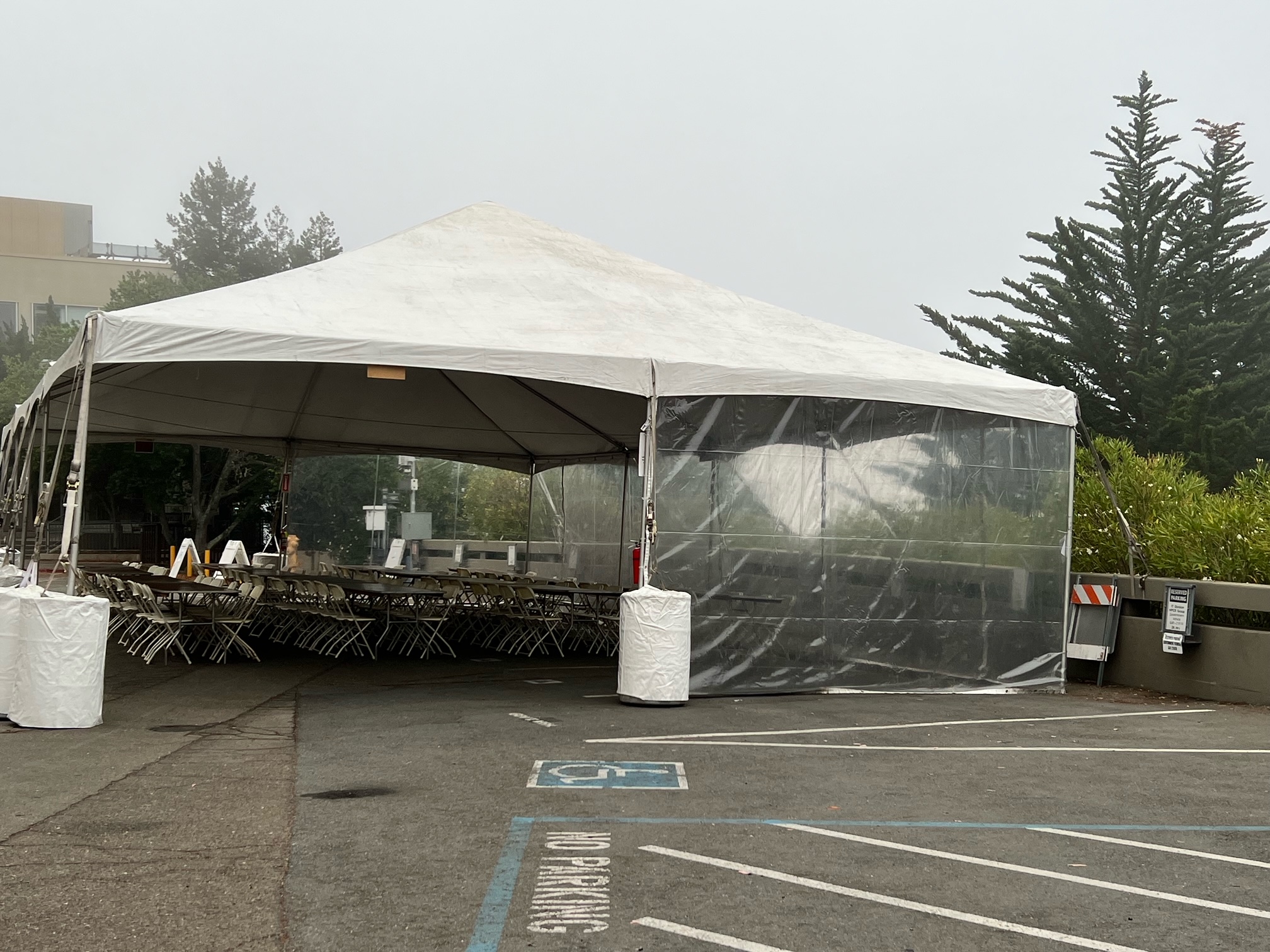
We’re getting things set up for the ESnet6 Unveiling tomorrow – our tent has gone up, we’re holding final rehearsals for the presentations, printing badges, and doing a thousand other small things.  

The only thing missing from our pictures is you! 

See you tomorrow for the big day, if you are visiting in person, travel safe, and if you are joining us virtually, the show starts at 9:00 AM on https://streaming.lbl.gov.

ESnet6 Investment Supports Next Generation Exascale Earth System Model

Scientists at Oak Ridge, Argonne, and Lawrence Livermore National Laboratories are collaborating on the next generation of integrated Earth climate models using Exascale Computing Project computers and simulation models. The Earth System Grid Federation program is building vast simulation models using data collected about our planet at all levels, from space to far below the surface. Predictions from these models are vital to our understanding of climate, ocean, and other complex systems that make life possible. Read more about this and ESnet’s role in this important international science conversation in a new phys.org article from Oak Ridge National Laboratory.

Visualization from the Earth System Model, one component of the Earth System Grid Federation program. ESnet provides the data connectivity necessary to stitch teams and computers at different labs together. Credit: LLNL, U.S. Dept. of Energy

The ESnet6 Unveiling Ceremony is 4 days away!  Come celebrate our new network and the great science we support, like the Earth System Grid Federation. Join us from 9 a.m. – 12 a.m., 11 October on https://streaming.lbl.gov.

Why We Designed and Deployed ESnet6: It is All About the Science!

We’re just a few days away from the ESnet6 unveiling and Confab22!

Here’s a great video interview with Ann Almgren, Senior Scientist in CCSE and the Department Head of the Applied Mathematics Department in the Applied Mathematics and Computational Research Division at Berkeley Lab. In it she discusses her research into wind power generation/distribution, and how she will use ESnet6.

Ann Almgren, Berkeley Lab

To watch the unveiling of ESnet6 and learn more about Ann’s research, join us 11 October from 900AM – 12 PM PT at streaming.lbl.gov!

ESnet6 Unveiling in Seven Days!

On October 11, 2022, we will welcome the newest generation of our high-performance scientific network, ESnet6, at an unveiling ceremony hosted by Berkeley Lab.

ESnet6 marks a new era of our high-performance network supporting the needs of scientists. We’re able to handle massive flows of data in a reliable, nimble way, and we can specifically configure our setup to match the needs of individual experiments. The upgrade ensures that ESnet is ready to support the future of science today, including the significant increase in the amount of data produced by scientific experiments and the increasingly complex needs of scientists and the way they interact with our network. 

Come watch the ESnet6 unveiling ceremony 9AM -12 PM PT, October 11, at streaming.lbl.gov!

ESnet team to give multiple talks about networking, automation, and QUANT-NET at NORDUnet Conference and GEANT’s SIG-NGN meeting

The 31st NORDUnet Conference will take place in Reykjavik, Iceland from September 13-15, 2022. 

ESnet staff will also be in attendance at the Special Interest Group on Next Generation Networking (SIG-NGN) on September 12, 2022, the day before the NORDUnet Conference.

Here’s where you can find ESnet team’s talks during these events: 

Monday, September 12, 2022: SIG-NGN

The next generation NREN lightning talks 
09:05 – 10:30am GMT

The lightning talks will feature two presentations from ESnet: 

  • ESnet Effort to Build Upon the NML and MRML – John MacAuley
  • LHC Next Generation Requirements Gathering – Eli Dart

Future network architectures. Technological change to support data moving / data planes 
11:00am – 12:30pm GMT

This session will start with 10-minute presentations, including two by ESnet staff:

  • ESnet7 – Chin Guok
  • Underlay Packet Inspection, Making Traffic Engineering Decisions at L2 – Yatish Kumar

These talks will be followed by a panel discussion. 


How do we stitch and share our L1-L3+ networks to introduce better and new services
12:00pm – 3:30pm GMT

This session includes a series of short talks, including:

  • Real Time Data Processing Requirements – Yatish Kumar

Yatish Kumar will also host a discussion on future networking technologies from =2:00pm – 3:20pm GMT


Tuesday, September 13, 2022: NORDUnet Conference

The ESnet6 Approach to Network Orchestration and Automation
11:00am – 12:30pm GMT | Track 1 / Room: Silfurberg B

Speaker: Scott Richmond

Abstract: Network Orchestration is a defining factor in next generation networks, enabling operators to deliver more consistent and reliable services. ESnet has leveraged a combination of internally developed tools, open source software, and commercial software to orchestrate and automate network configuration deployment. This approach has enabled rapid deployment of new network services, as well as ensuring that configuration standards are well enforced when deploying network services.

During this talk, we will provide a brief history of automation at ESnet, dive into what our goals were for orchestration and automation in the ESnet6 project, and describe the technology and process that we used to meet those goals. Finally, we will discuss the hurdles encountered and lessons we learned along the way while developing this tooling.

Eli Dart was part of the technical program committee and is the chair for the HPC session, taking place in Track 2 / Room: Rima from 2:00 – 3:30 pm GMT. 


Wednesday, September 14, 2022: NORDUnet Conference

Experimenting with Teleportation Based Physical Layer for the Network: QUANT-NET
1:30pm – 3:00pm GMT | Track 1 / Room: Silfurberg B

Speaker: Inder Monga

Abstract: QUANT-NET takes an application-centric and systems-based approach to building a Quantum Internet testbed. The main thrust of this effort is to build a three-node distributed quantum computing testbed between two sites, Lawrence Berkeley National Lab and the University of California Berkeley (UCB) connected with an entanglement swapping substrate over optical fiber and managed by a quantum network protocol stack. We will implement the most basic building block of distributed quantum computing by teleporting a controlled-NOT gate between two nodes. This approach will enable research, prototyping, measurement and testing of the entire quantum network stack from physical layer to the application. The talk will describe our proposed testbed and progress.


ESnet’s Wireless Edge: Extending Our Network to Support Field Science

Throughout the world, earth and environmental scientists are deploying new kinds of sensors to measure and understand how the climate is changing and how we can best manage key infrastructure and resources in response. 

Operation and data analysis of these sensors can often be challenging, as they are deployed in areas with limited power, sometimes with no data connectivity beyond the periodic physical collection of memory cards. Sensors may be in areas where weather and other factors make access laborious and challenging, such as at the top of a mountain, down a borehole, or under dense forest canopy.

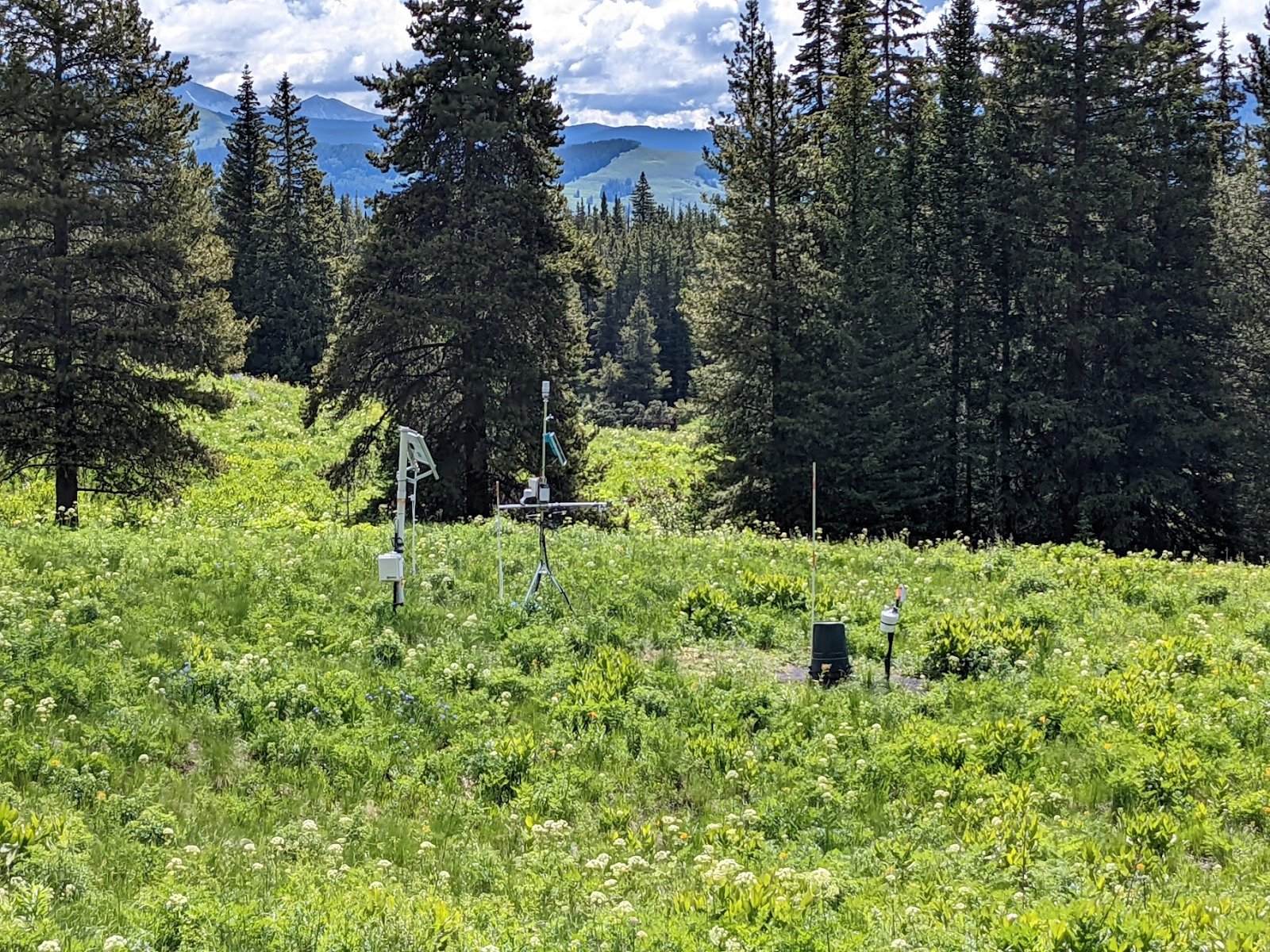
Solar-powered meteorological and hydrological sensors deployed at the Snodgrass Field Site, Crested Butte, July 2022 at approximately 9,000 ft. elevation. (Photo: Andrew Wiedlea)

As the number, types, and capabilities of these sensors increases, the U.S. Department of Energy’s (DOE) Energy Sciences Network (ESnet) is working on ways to extend its high-speed network to support the needs of scientists working in remote, resource-challenged environments where our fiber backbone cannot be extended. Using advanced wireless technologies such as low-Earth orbit constellations, 5G, and private citizen band radio system cellular, mmWave, and Internet-of-Things tools like long-range (LoRa) mesh networks, we are developing ways to remove the limits of geographical constraints from field scientists, just as we have traditionally sought to do for laboratory scientists around the DOE complex.

In early July this year, ESnet took a step forward in these efforts by installing a private cellular network near Crested Butte, Colorado, supporting sensor fields being used by Earth and environmental scientists on Lawrence Berkeley National Laboratory’s (Berkeley Lab’s) Surface Atmosphere Integrated Laboratory program.  

The purpose of this effort is to assess requirements for operation of a private 4G/5G wireless network in a remote and changing environment, which can pull ESnet capabilities and services supporting scientific research out beyond our performant 13,000 km optical backbone. We are also using this research to identify specific operational, workflow, and data movement needs for the Earth and environmental science community as part of building ESnet’s logistics, operational, and human capital resources available to support the Earth and environmental science mission.

Our system, which is currently being configured, is built around a Nokia Digital Automation Cloud private cellular capability, with antennas being placed across a valley from sensor fields at the Snodgrass Field Site in Crested Butte. The intent is to use this cellular service to automate and improve the efficiency of data collection from sensors, using cellular routers and radios, depending on the specific capabilities of each sensor system. For those sensor systems that cannot be directly connected to a cellular network, we are establishing solar-powered sensor stations that will provide local area bridge (several hundred meter) connectivity to local sensors via wifi, LoRa, or direct ethernet cable. 

Once data is backhauled from a sensor field through our private cellular network, it will be transmitted back to ESnet via SpaceX’s Starlink low earth orbit satellite system, connecting to ESnet at a peering location in Seattle, Washington, and then through our optical backbone to the National Energy Research Scientific Computing Center at Berkeley Lab for processing and storage.

With fantastic assistance and collaboration from the Atmospheric Radiation Monitoring program, the Rocky Mountain Biological Laboratory, and Dan Feldman and Charulekha Varadarajan in the Watershed Function Science Focus Area at Berkeley Lab, our first field campaign was both great fun and extremely productive. 

We will return later in the Fall to complete network configuration and connection of sensors to the network. Once this is done, we can begin the next phase of this research: studying the operational performance and service requirements necessary to support field science through the demanding conditions provided by winter in the Colorado High Rockies. We will also begin to develop standard deployment equipment specifications and practices that we can use to support ESnet wireless edge deployments supporting science in other regions and for other purposes.  

This effort is being made possible by teamwork across ESnet and Berkeley Lab, including outstanding support at Berkeley Lab from Chris Tracy, Jackson Gor with ESnet network engineering, and Steve Nobles and many others with IT Telephone Services. The Colorado deployment success depended on the hard (often physical) work of Stijn Wielandt-EESA, Kate Robinson (ESnet Network Engineering), Jeff D’Ambrogia (IT-Science IT), and Jeff Chavez with Nokia.

Chris Cummings Speaks About Service Orchestration at Networking Field Day

ESnet’s Chris Cummings from our Orchestration and Core Data team was asked to present at the industry event “Networking Field Day: Service Provider”. 

Networking Field Day (NFD) is a unique event in which industry professionals are invited to join a panel of delegates who are presented with new products and offerings from networking vendors. These presentations then follow an open format where delegates can ask questions of the vendors and understand more about the products being discussed. 

For this particular instance of NFD, Chris was invited as a community member to present on how ESnet has built service orchestration and intent-based networking tooling, which allows us to abstract our service offerings from the technical implementation details that compose them. This is a topic that has a lot of mystique and buzz-words surrounding it in the networking industry, but this presentation contains concrete examples and demonstrations of the software that ESnet uses daily. 

The talk Chris gave explored ESnet’s approach to building a service orchestration software suite. He also gave a few demonstrations of the software in action. This presentation is not an exhaustive explanation of how to build your own intent-based networking environment, but rather an example and overview of a real-world stack that is being used in a production network today and the principles behind it. 

Watch Chris’s presentation here: https://techfieldday.com/appearance/a-real-world-approach-to-intent-based-networking-and-service-orchestration/